

Historical Background
Marienburg Castle is a recognized cultural monument of national importance. It plays a key role in shaping the identity of Lower Saxony, and especially the former state of Hanover. Construction began in 1858 for Queen Marie of Hanover (1818-1907), who received the castle as a gift from her husband, George V (1819-1878), the last King of Hanover.
The architect in charge of the project was Conrad Wilhelm Hase, a leading figure of North German Historicism. During the construction period, he was replaced by the architect Edwin Oppler, whose other major works included the synagogue in Hanover, destroyed in 1938. The interior design of the palace, in particular, conceived by Oppler, is among the most sophisticated examples of Historicist architecture and interior design, not only in Lower Saxony.
Construction of the castle was interrupted shortly before completion after the Kingdom of Hanover was annexed by Prussia. This is one reason why the cultural monument holds special significance for Hanover's identity. Until 2020, Marienburg Castle was the private property of the former House of Welf, now represented by Ernst August, Hereditary Prince of Hanover, born in 1983. He, together with the State of Lower Saxony, found a comprehensive solution that keeps the castle accessible to the public and ensures its urgently needed, extensive restoration. A key component of this solution is the transfer of the property and its contents to the Marienburg Castle Foundation, established by Ernst August, Hereditary Prince of Hanover.
Since the castle was only sporadically inhabited, it has undergone few alterations and has been largely preserved as a unified work of art. It therefore offers visitors the opportunity to experience an authentic royal summer residence. An integral part of the Marienburg complex is its culturally and historically valuable inventory. This includes the castle's original furnishings as well as numerous other works of art that were brought to Marienburg from other Welf castles, primarily after 1945. The intrinsic value of this inventory is part of Lower Saxony's regional identity and cannot be measured in monetary terms.


Current construction activity

The building renovation
165 years have left their mark. Leaks in the building envelope, dry rot, and eroding ground have, over the years, jeopardized the structural integrity of Marienburg Castle. Renovation of the castle became unavoidable.
The Federal Government Commissioner for Culture and the Media (BKM) and the State of Lower Saxony are providing a total of approximately 27 million euros for the renovation of Marienburg Castle.
Since November 2022, the engineering firm Schütt Ingenieurbau GmbH & Co. KG has been managing, directing, and overseeing the renovation project. With the commissioning of pmp Projekt GmbH as general planner in August 2023, the process of building and specialist planning began. It quickly became clear that Marienburg Castle is surprisingly under-researched. Important information about building materials, techniques, and the extent of damage to the building and its historical interior furnishings was lacking.
Following extensive preliminary investigations and completion of the preliminary planning, it was determined which measures could be implemented with the available funds. Prioritizing these measures according to urgency resulted in the following sequence of construction phases:
-
Emergency stabilization of the arcade and chapel roof
-
Slope stabilization and south terrace
-
South, west and east wings
Construction phases 1 and 2 are indispensable due to the extent of the damage and also create the structural prerequisites for the main work.
The third construction phase includes not only the urgently needed renovation of the roof, facades, windows and doors, but also the conversion of the ground floor in the south, west and east wings into a museum space.

Construction phases
The pergola
East of the castle, a steep rock face runs along the surrounding retaining and curtain walls. An open arcade of natural stone, supported by arches and corbels, rests on this slope. Years of vegetation and penetrating moisture have loosened the rock slabs and eroded material. Due to this progressive damage, the corbels and the underlying masonry now lack sufficient support.
– The pergola is in imminent danger of collapse! It must not be entered!
Construction phase 1, the emergency stabilization of the arcade, presents a particular challenge: Five cantilevered steel beams will support the load-bearing corbel stones from above. Subsequently, in construction phase 2, the loose rock sections can be fixed with anchors and secured with a shotcrete shell.
This creates a new support surface for the brackets and secures the pergola.

Damage to the eastern slope
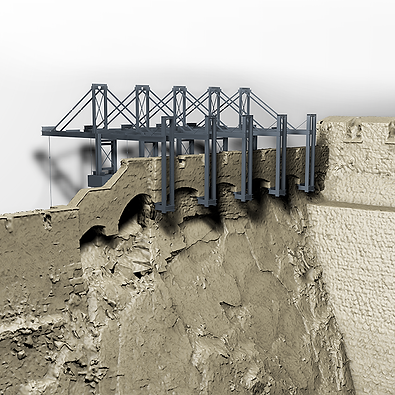
3D model of the emergency stabilization structure
The south terrace
One of the distinctive architectural features of Marienburg Castle is its large south terrace. However, it too is in dire need of renovation. Numerous cracks and fissures now crisscross the terrace surface, clearly indicating that unintended movement has occurred. The terrace surface has subsided significantly. Viewed from below, the connection to the high retaining wall becomes apparent. The masonry shows cracks and, particularly in the lower half, severe signs of weathering. In these areas, the retaining wall has deformed horizontally.
Now the causes must be investigated and suitable measures developed to secure and stabilize the terrace.
The stability of the south terrace is a prerequisite for erecting scaffolding on the south wing, which is needed for the 3rd construction phase.

South terrace from above
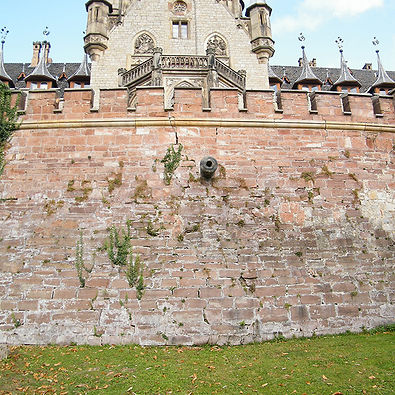
retaining wall of the south terrace
The roof covering
Marienburg Castle boasts a highly varied roofscape with numerous gables, turrets, dormers, and chimneys. This characterizes the castle's appearance and contributes to its picturesque charm.
Over time, numerous connections between the roof covering and the building have become leaky. The historic roof tiles show extensive damage: many have broken due to weathering and storms.
For the roof renovation, the historic tiles are being removed and – provided they are undamaged – stored. To protect the interior from rain during this time, a large weather protection roof is being erected over the building wings.
After the roof structure has been repaired, a solid underlayment will be applied and all defective components, drainage channels and pipes will be replaced.
Finally, the roof is re-covered with a mixture of stored historical and re-fired tiles.

Roof of the northwest gate area

Example of a weather protection roof
The roof and ceiling construction
The roof structure is largely visible. However, the construction of the timber beam ceilings and the adjoining roof components are mostly concealed by floors and ceilings. Spot checks in these areas already reveal significant damage.
They are partially infested with wood-destroying fungi (including the "dry rot fungus"). The fungi decompose the wood, making it brittle and causing it to lose its load-bearing capacity. This is visible in the characteristic cubical fracture of the wood. The fungal mycelium of the dry rot fungus is able to spread into masonry and other materials. It can cover considerable distances throughout the entire building.
To determine the exact extent of the damage, experts are currently opening up numerous structural components throughout the castle. Only after this preliminary investigation can the necessary repairs to the roof and ceiling structures be planned in detail. It is already clear that the beams in the roof area, in particular, will need to be repaired or replaced.

Damaged beam end in the attic

Example of a renovated roof
The facade
The facades of Marienburg Castle are constructed of natural stone masonry. A special detail is the small limestone blocks (reinforcing stones) that have been inserted into all the joints of the masonry.
Weathering and rain have washed out the joint mortar, especially in exposed areas: the lime binder is missing, and loose sand is trickling out. The numerous decorative elements of the facades are also, in some cases, significantly damaged – they show defects, spalling, and surface damage. The iron anchors are corroding, expanding, and breaking off pieces of the sandstone.
Where the aged mortar no longer fulfills its function, it is removed from the joints. Damaged old repairs are treated the same way. Then, the joints are repointed using a material compatible with the historic building fabric. The small decorative stones in the joints are a characteristic design feature and are reinstated.
Broken-off sections caused by corroded iron anchors are repaired and loosened architectural elements are reattached.
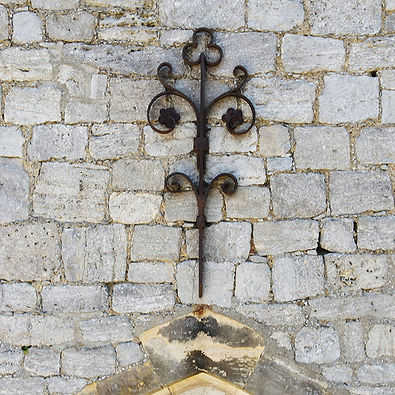
Western facade of the chapel

Damage to the joints of the chapel facade
(Red: Missing area, Violet: Sanding, Dark grey: Replacement)

Emergency stabilization of chapel roof (1)

Emergency stabilization of chapel roof (2)
The roof of the castle chapel
During the course of the renovation work, it was discovered that the structure of the chapel roof had sustained significant damage and that emergency stabilization of the supporting beams was necessary.
A new steel beam was then installed, which now correctly distributes the forces within the structure. The danger of collapse was thus averted.
The future of Marienburg Castle
The construction work is scheduled for completion in 2031. At that point, the castle's structural integrity will be restored, and it will have adequate fire protection and be ready for permitted use.
The foundation plans to operate the castle again as a museum, create a gastronomic offering and use it again as an event venue.
The museum concept
At the beginning of 2020, the state of Lower Saxony, together with the Cultural Foundation of the German Federal States (KSL), developed the project “Marienburg 2030”, which started in July 2020.
The project originated with the transfer of Marienburg Castle from the private ownership of the former Hanoverian royal family to the Marienburg Castle Foundation. Since January 2020, the foundation has owned the property and its contents, with the exception of the painting collection, which the State Museum of Hanover acquired with the support of the KSL and other sponsors.
The transfer of these artworks into public ownership is linked to the responsibility of ensuring their permanent public accessibility within the castle. In addition to extensive structural renovation, this also includes the conservation and scholarly and museum-based development of the art and cultural assets housed at Marienburg Castle. As part of this complex undertaking, the "Marienburg 2030" project was launched in 2020, with the goal of establishing a new museum at Marienburg Castle.
After the feasibility study was confirmed, the project team began developing a master plan in 2022. Building on the insights gained previously, a sustainable museum usage concept was developed through interdisciplinary collaboration, which is now to be implemented step by step.